All you need to know about composting

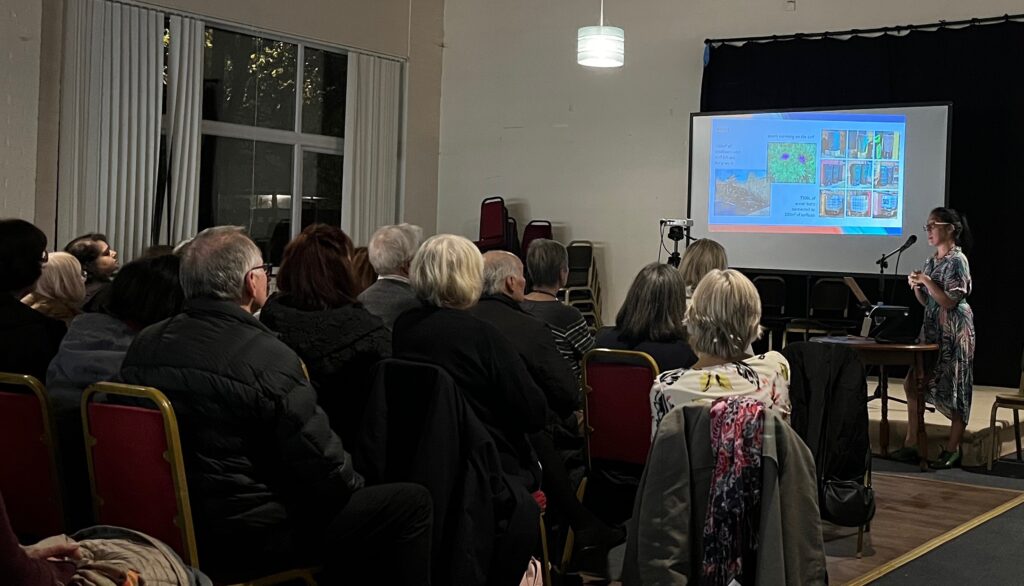
Elaine Fieldhouse & Barry Reeves, both local gardeners, gave a fascinating talk at April’s AHS meeting about compost.  Elaine who has  a wonderful garden backing on to an allotment in Plaistow has 22 compost bins including 4 tumblers.  She explained  that the material in each compost takes about 6 to 8 months to break down.  Elaine creates wet compost with some plants – adding water to plants to make a slurry then she adds it to her compost bin.  She told us that rhubarb leaves break down quickly; that she packages kitchen waste adding water to make it more moist and she adds cardboard to wet compost .  Dry cardboard needs to be dampened. She doesn’t add any cooked food.  The advantage of home grown compost over bought compost is that its free and you know what goes into it.  Asked about adding weeds to compost bins she explained that weeds don’t come back if they are well rotted.  Elaine uses her home grown compost to mulch her garden and allotment carried out in October/November and then February.
Barry told us about using a Hot Compost bin.  The advantage of a Hot Bin is that it will fit into a small garden.  He told us to stick to the instructions provided with the bin – a starter bottle of liquid is provided at the beginning as well as wood chips it is important to add wood chips and shredded paper and cardboard to keep the contents of the bin aerated. The bin is provided with a kind of stirrer with which one can stir the contents. The contents of the bin get very hot as the bin is covered with a sort of polystyrene to heat the contents – the temperature gauge on the lid shows the temperature of the contents. When you open the hot bin you can see the steam coming from it. You can add cooked food to a Hot Bin as well as green garden waste but better to chop it up so that it breaks down quicker.  The contents of the bin should never be solid and the heat is enough to kill weeds.  At the bottom of the bin there is a blue tap from which you can drain liquid plant food.  Barry told us that he gets about 5 buckets of compost after 2 months – the compost is of great quality and doesn’t smell.

Celia Parker – A Year On The Plot. 

At the March meeting of Aldersbrook Horticultural Society Celia Parker gave an excellent talk about her allotment. She began by outlining the benefits of having an allotment; to keep us healthy & fit; to be outside in the fresh air and to produce good organic food which has not travelled any distance. She took us through what she does each month, from chitting seed potatoes in February ready to plant out in April; weeding & mulching Asparagus in March, to sowing a variety of vegetable seeds in April and May followed by the joys of harvest in the Summer and Autumn months.  As well as fruits and vegetables Celia likes to grow flowers on her plot such as Allium, Bearded Iris & Tulips which she cuts to bring into the house.   Pictures of wheelbarrows full of delicious produce harvested in the Summer months were displayed.  She described to us what she does with her harvest of crops from freezing Peas and Broad Beans to making jams with soft fruits such as Strawberries and Raspberries.  Celia showed us a picture of her sun bubble in which she grows an abundance of Aubergines, Peppers and Tomatoes.   

In the Autumn months Celia grows a number of Pumpkins given to friends and family with children to celebrate Halloween. She told us all that she has a very good recipe for marrow chutney which many of us will want to use, I’m sure!  She explained that on her plot Celia and her partner Harry grow a lot of beans which are then frozen for 72 hours before stored dry to be used through the year – the freezing gets rid of any weevils. They do not dig up their potatoes but leave them in the ground all year and dig them up when they need them – this means they don’t grow shoots while they are stored. Celia uses the lasagne method of mulching by placing cardboard on the soil in the Autumn and Winter and putting manure on top of the cardboard.  So the year on the plot comes to an end in December and January when it is a good time, Celia suggested, to go through the seed catalogues and order seeds for the following growing year.  Also in this quiet time she draws her plan, which she showed us, to ensure that crops are rotated to avoid any disease or pests that may remain in the soil.  There were a number of interesting questions to Celia and many of us were inspired to start seed sowing and go back to our plots to clear the weeds and start planting as soon as the weather allows.

Talk by Fergus Garrett at AHS February meeting

Fergus Garrett, the Head Gardener at Great Dixter and CEO of the Great Dixter Trust spoke to members and friends at Aldersbrook Horticultural Society’s February meeting. He spoke of learning from the great gardener Christopher Lloyd who owned Great Dixter. They worked together for many years and Christopher Lloyd was Fergus’s mentor. His talk was on Succession Planting, explaining how to ensure that our garden borders and beds can look good all the year round by planting different plants in succession, leaving no gaps in the soil at any particular time of the year. He explained which plants work well together, for example, growing small and relatively slow growing spring bulbs under deciduous trees or with ferns and hostas before they come into leaf. He explained how important it is to use shrubs for all round interest and provide shape and mass in the border. He said some plants would be too thuggish to plant with others and emphasised how important it is to plant the right plant in the right place and showed how even different varieties in the same genus of plant will develop in different ways and emphasised the importance of observing your plants and how they grow. The audience was wowed by beautiful slides showing how each area of planting changed through the seasons and how some plants take over when others die back or disappear underground. He recommended marking out a border so that you know which plant or seeds can be planted in which section of the bed. At the end of his talk, Fergus answered a number of questions from enthusiastic members of the audience, who gave very positive feedback and we hope to invite him for another talk next year.